On 8 September 2025, President Tokayev delivered his annual State of the Nation address to the Kazakhstan parliament. Its title: "Kazakhstan in the Era of Artificial Intelligence: Current Challenges and Solutions through Digital Transformation". His message was unambiguous:
"The rapid development of artificial intelligence is already influencing the worldview and behaviour of people… There is no alternative to this… We must act decisively — any delay could lead to the most severe consequences. That is why I have set a strategically important goal: to turn Kazakhstan into a fully digital nation within three years."
This was not an isolated statement. Over the past year, Kazakhstan has accelerated its state-led AI development programme. It passed Central Asia's first Law on Artificial Intelligence, unified its legal framework under a new Digital Code, established a new Ministry of Artificial Intelligence and Digital Development, converted the Expo-2017 site in Astana into a flagship AI hub, and rolled out a succession of investment announcements and institutional reforms. The government has not simply responded to AI. Instead, it has positioned itself as the primary sponsor and champion.
Globally, private investment drives AI development, with governments reacting through regulation. Kazakhstan is following a structurally different path: the state sets the agenda, funds the infrastructure, and announces the results. That makes news coverage of AI especially worth examining. When the government is simultaneously building, funding, and publicising AI initiatives, what picture of national AI development do citizens see?
This article asks whether Kazakhstan's recent AI news cycle merely echoes global hype, or reflects a distinctive framing considering the state's investment in AI.
By analysing 663 articles published between 2023 and 2025 across six major media outlets, we examine which aspects of AI received sustained attention in the news, which were left out, and why.
Why This Study Matters
To our knowledge, this is the first systematic analysis of AI media framing in Central Asia and the post-Soviet space. Existing research has examined AI coverage in the United States, the United Kingdom, Germany, China, and a range of other contexts, but the region remains a significant gap in the literature on how AI is discussed in public discourse.
Kazakhstan's case is also structurally distinctive. Virtually all existing AI framing studies examine contexts where artificial intelligence is primarily a market phenomenon: companies build it, investors fund it, and governments react with regulation. Kazakhstan presents the inverse: a government-led model in which the state is the primary actor. Development economists call this a developmental state, the pattern Japan followed in the 1960s and South Korea in the 1970s, where the government orchestrates technological transformation as a national project. That changes the analytical question. The central tension is not between innovation and regulation, but between a state-sponsored modernisation narrative and the governance questions, including accountability, oversight, and rights.
A third contribution is conceptual. A common assumption in comparative media research, drawn largely from Western democratic contexts, is that editorial independence produces meaningfully different coverage. Outlets less beholden to state interests, the assumption goes, will be more likely to foreground governance concerns and critical perspectives. Our findings do not support that assumption for this case. What best distinguishes articles that discuss governance from those that do not is not the outlet that published them but their length: governance discussion appears in longer pieces and is largely absent from the short institutional news briefs that dominate AI coverage. We return to this in detail below.
What Influences the Public Understanding of AI
This article does not evaluate artificial intelligence in technical terms. It examines how AI is discussed in the news, and why that matters for public understanding.
When most citizens encounter information about new technologies through the news, the way a topic is framed shapes how it is understood. Media researchers use the concept of framing to describe the process by which news coverage selects certain aspects of an issue to highlight and leaves others in the background. Over time, those choices accumulate into a picture of what a technology is, what it is for, and who benefits from it. A related concept is agenda-setting by omission: issues that receive little attention in routine reporting may remain less visible in public debate, even when they are substantively important. A third, the spiral of silence, describes how concerns consistently absent from public discussion can come to seem marginal or inappropriate to raise at all.
Public attitudes in Kazakhstan provide an important backdrop. Survey-based research suggests that technological optimism is relatively widespread. Digital public services, mobile banking, and online platforms have improved everyday convenience for many citizens, reinforcing the perception that new technologies generally produce practical benefits. Comparative research indicates that publics in Asian societies tend to exhibit higher acceptance of new technologies than many of their Western counterparts. In such an environment, media coverage of AI may naturally emphasise opportunity and efficiency rather than potential risks, not necessarily by editorial design, but because that framing resonates with how audiences already think about technology.
Researchers of technology politics have a useful term for this: a sociotechnical imaginary, meaning a collectively held and institutionally supported vision of a desirable future built around technology. "Kazakhstan in the Era of AI" is exactly such a vision. What matters about the concept is that it does not require anyone to be instructed. A shared imaginary reproduces itself because people genuinely believe in it.
But audience expectations alone do not explain what we find. Kazakhstan's media landscape has structural features that make this more than a story about optimistic readers. Ownership structures, editorial positioning, and commercial incentives all shape how technological developments are covered. As scholars of hybrid political systems have observed, governments do not always exert influence through direct censorship: they can shape the information environment through economic incentives, procurement relationships, and the steady promotion of narratives that associate state-led initiatives with national progress. Media researchers call this media capture – influence exercised through financial dependency rather than instruction. In Kazakhstan, the main channel is the goszakaz system of state media procurement, and most major non-state online outlets receive such contracts. Coverage of government AI initiatives may therefore emphasise implementation and expected benefits while leaving accountability concerns less visible, not through instructions to journalists, but through the structural conditions in which journalism is produced.
Our Study
To understand how AI is framed in Kazakhstan's news media, we analysed 663 articles published between January 2023 and December 2025 across six online outlets, drawn from a larger collection of 1,098 AI-related articles. The analysis covers news reporting, while opinion columns, sponsored content, interviews, and aggregated roundups were set aside so that we were comparing like with like.
| Outlet | Articles | Position | Notes |
|---|---|---|---|
| baq.kz | 222 | State-aligned | State-owned; subsidiary of Kazinform |
| Tengrinews.kz | 161 | Pro-government commercial | Privately owned (Alash Media Group); around 5 million monthly views |
| Informburo.kz | 138 | Pro-government commercial | Privately owned; over 8M monthly views |
| Kazinform | 75 | State-aligned | Official national news agency |
| Ulys Media | 41 | Alternative | Positions itself as independent |
| Vlast.kz | 26 | Alternative | Independent; OCCRP network member since 2022 |
| Total | 663 | Technews.kz (58 articles) analysed separately as a comparator | |
These outlets were selected because they reach large national audiences, publish substantial volumes of digital news content, and represent meaningfully different institutional positions within Kazakhstan's media landscape. Informburo.kz reports over 8 million monthly views and Tengrinews.kz around 5 million; Vlast.kz and Ulys Media each position themselves as independent. Including state-aligned, pro-government commercial, and self-described independent outlets allows us to test whether editorial orientation shapes AI coverage in practice, not only in theory. Technews.kz, a technology-specialist outlet, was collected as a comparator and analysed separately.
Most articles are written in Russian, which over 80% of Kazakhstan's citizens speak as a daily language. Some outlets publish in both Russian and Kazakh, but Kazakh-language AI coverage is either absent or closely mirrors the Russian content. The analysis therefore focuses on Russian-language articles, which constitute the overwhelming majority of substantive AI-related reporting across all outlets.
How We Analysed the Articles
To identify recurring themes, we used a dictionary-based content analysis: a method in which software scans article texts and counts words that match, or share a root with, a predefined list of keywords associated with particular topics (e.g., "startup," "AI"). The categories were drawn from established frameworks in media framing and AI governance research rather than invented ad hoc: modernisation, efficiency, ethics, surveillance, and data privacy are the standard dimensions identified in the existing literature.
We then looked at articles from two contrasting perspectives and built a composite index for each. The Modernisation Index counts how many progress-oriented themes an article touches: innovation, productivity, economic development, administrative efficiency. The Risk Index counts how many risk-oriented themes it touches: surveillance, ethics, data privacy. Comparing the two tells us which lens dominates, whether an article is written in the register of opportunity or the register of caution.
A separate measure, the silence indicator, flags articles that discuss AI without mentioning ethics, data privacy, or transparency at all. It tests whether these topics are absent even in articles where they would be directly relevant.
Because not all governance language does the same work, we went one step further. Every article that did mention governance was sorted into one of three kinds: declaratory, protective, or disciplinary, according to whether its governance language specifies actual rules, obligations, and consequences, or merely invokes governance as an aspiration. These categories are defined and illustrated in the section "Not all governance talk is the same" below. We also recorded who was quoted in each article, and ran a title-similarity analysis to examine whether outlets publish similar AI stories simultaneously or sequentially, a window into how closely coverage tracks shared official sources.
Before conducting the analysis, we expected two patterns: that coverage would frame AI primarily as a tool for economic development and administrative efficiency, and that independent outlets would discuss governance concerns more frequently than state-aligned ones. The results below examine whether those expectations were borne out. The first was. The second was not.
The Dominant Narrative: AI as Modernisation and Efficiency
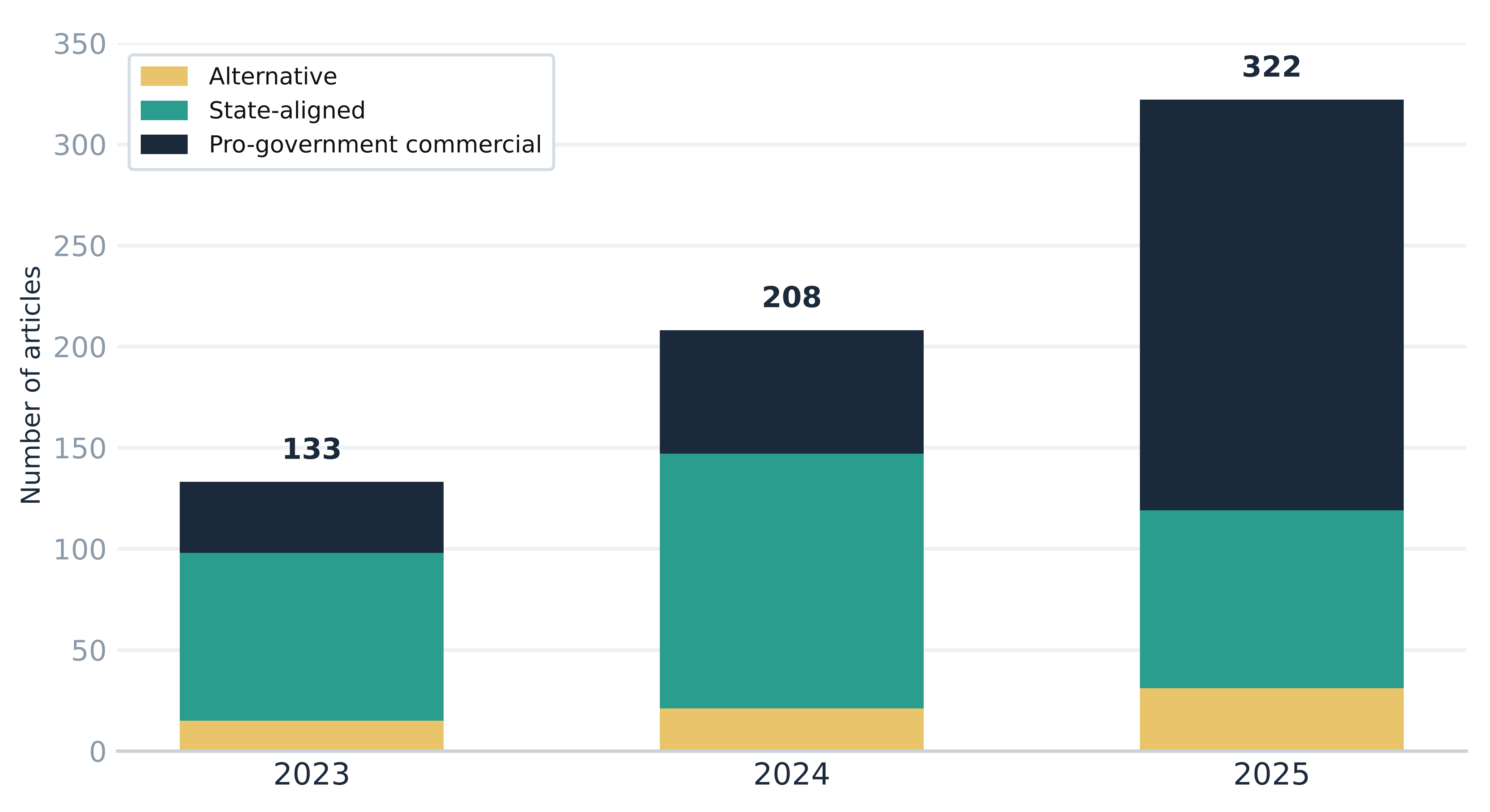
Across the six outlets we tracked, AI-related news articles numbered 133 in 2023. In 2024, that rose to 208. By 2025, the same outlets were publishing 322 a year (Figure 1). The surge in the second half of 2025 is not hard to explain: President Tokayev's September address, which explicitly devoted Kazakhstan's national agenda to AI, produced a wave of follow-up coverage across every outlet in our dataset. Monthly volume during August–October 2025 ran at 3.1 times the 2023–2024 average. When the head of state makes AI the theme of the year, the news cycle follows.
The content of that coverage follows a remarkably consistent pattern. Across all outlets, AI is overwhelmingly discussed through the lens of modernisation, innovation, and administrative efficiency. Articles link artificial intelligence to digital platforms, e-government services, and economic competitiveness. The language of progress, including faster services, improved performance, and national development, runs through coverage regardless of which outlet you are reading (Figure 2).
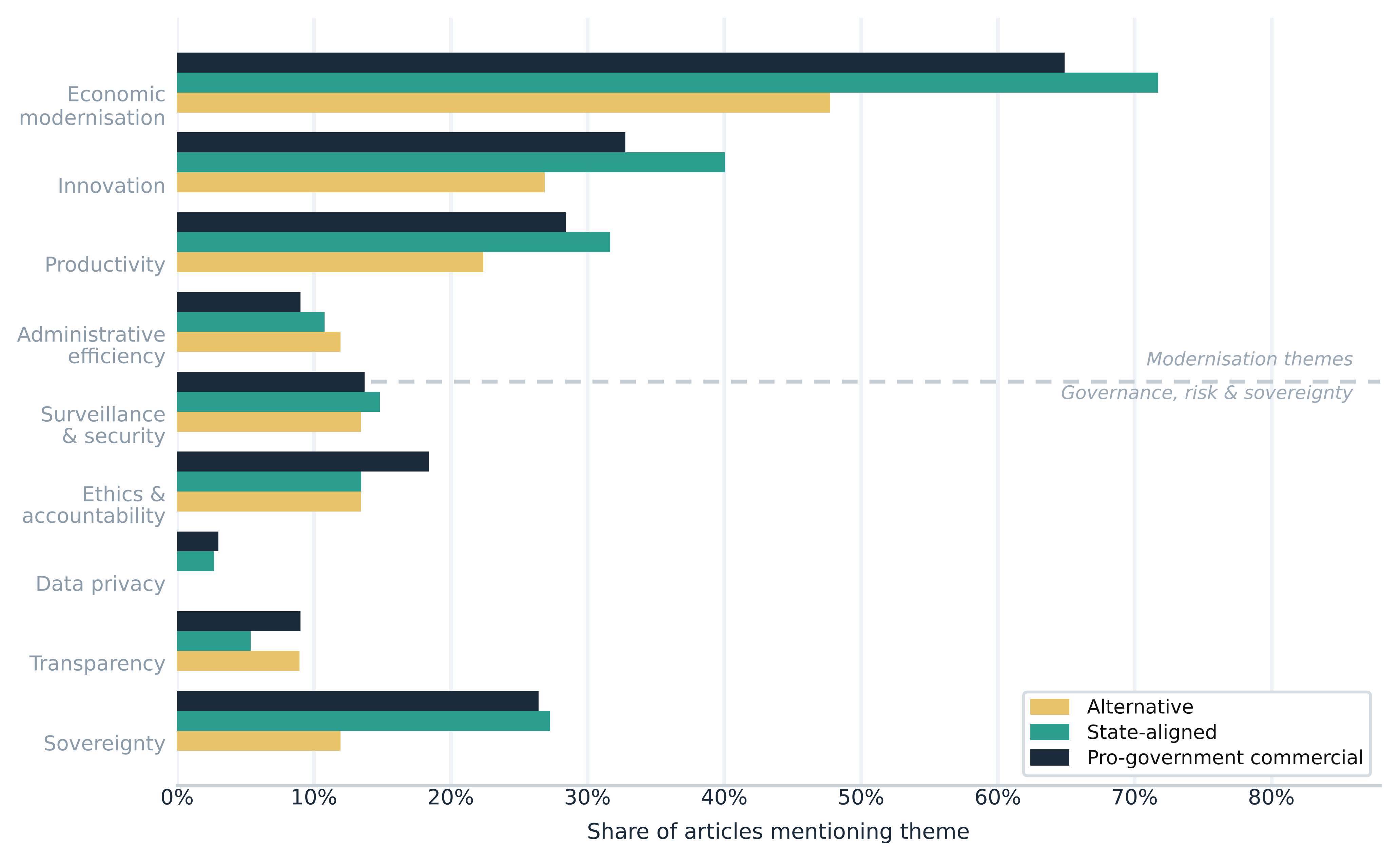
The Modernisation Index exceeds the Risk Index in every single outlet, and by a wide margin in each, across every subset of the data we tested. This pattern reflects, in part, how the coverage is produced. Outlets like Tengrinews and baq.kz function partly as news wires, and their coverage of government AI initiatives frequently recites the official announcements. When President Tokayev's address declares that there is "no alternative" to digital transformation and that "delay could lead to the most severe consequences," news outlets tend to report the speech rather than add any additional commentary.
One specific pattern is worth noting. When surveillance and security language appears in AI coverage, it clusters most strongly with economic modernisation, not with ethics or accountability. Facial recognition systems and monitoring technologies are discussed as tools of efficiency and public service improvement, not as subjects requiring democratic oversight. The governance dimension of surveillance technology is largely absent from the frame in which it is reported.
Sovereignty, Language, and Other Kazakhstan Themes
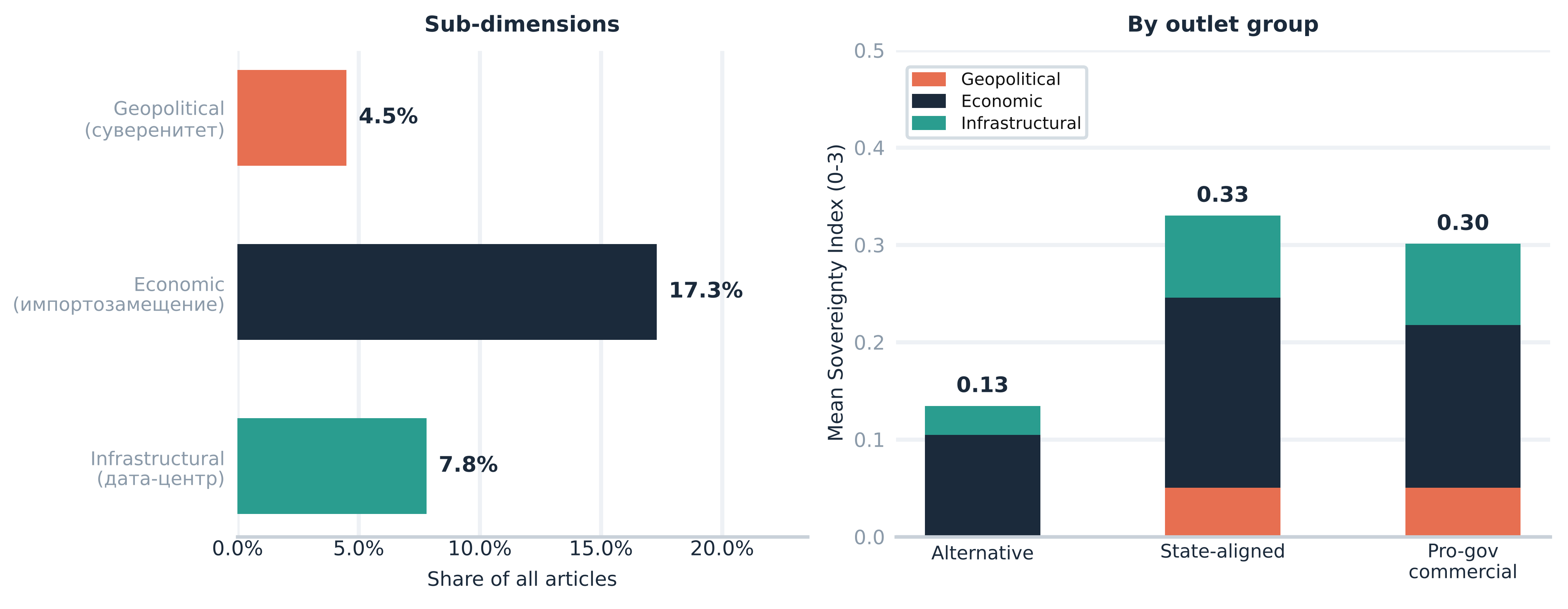
Some themes in the coverage seem to take a distinctively Kazakhstani form. Digital sovereignty language appears in 25.3% of articles, but breaking it apart is revealing. The distinction turns on what is being claimed. Geopolitical sovereignty concerns who controls the technology (the language of 'suverenitet' and independence from foreign technological dependence) and appears in only 4.5% of articles (Figure 3). Economic sovereignty concerns where the technology is made (import substitution, domestic production, Kazakhstani-built platforms) and is far more common, at 17.3%. Geopolitical sovereignty is also almost entirely a state-aligned theme: it does not appear at all in alternative outlets.
The most distinctively Kazakhstan theme is language and nation-building: coverage of KazLLM and other Kazakh-language AI models, state-language technology policy, and the place of Kazakh in a digital future. It appears in 9.0% of articles. Multi-vector geopolitics, Kazakhstan's doctrine of balancing between Russia, China, and the West, applied to AI cooperation, appears in 5.7%.
Two risk-related themes are worth noting for what they reveal by comparison. Labour displacement (job losses, retraining, automation anxiety) appears in 9.2% of articles. Stories about people actually harmed by AI systems appear in 8.6%. Each of these is roughly as common as substantive coverage of AI regulation. Economic anxiety and individual harm are discussed relatively frequently in Kazakhstan AI coverage. Institutional accountability is considerably less so.
What Is Missing: The Governance Gap
Imagine reading a week's worth of coverage about a powerful new drug without encountering a single sentence about side effects, clinical oversight, or patient rights. The drug is not being promoted dishonestly since it can genuinely be effective, approved, and available. However, leaving out the risks still shapes the story.
This is broadly what our data shows for AI coverage in Kazakhstan. Ethics, data privacy, algorithmic accountability, and transparency appear infrequently. When they do appear, they are usually brief and technical rather than substantive. Our silence indicator measures this directly by counting an article as silent when it discusses AI without mentioning any of these governance concerns.
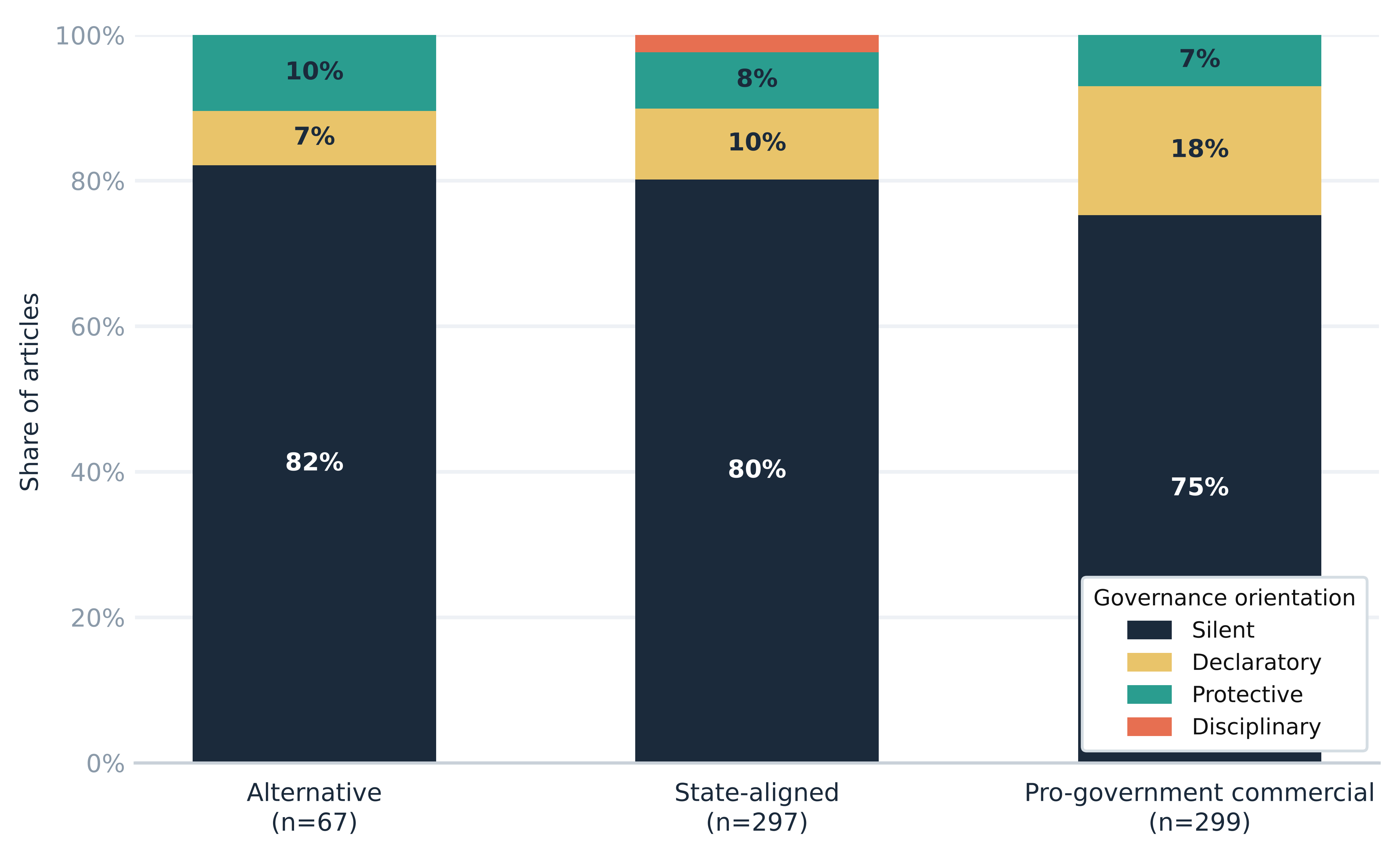
The results reveal that across the dataset, 78.1% of AI news articles make no reference to ethics, data privacy, or transparency (Figure 4). That figure barely moves when we restrict the analysis to articles where governance concerns would clearly be relevant: coverage of AI in law enforcement, public administration, or smart city contexts. In those domains too, silence on governance is the norm, not the exception.
There are additional topics largely invisible in AI coverage beyond the ethics and privacy gap. The financial cost of Kazakhstan's AI investments, what these programmes cost the public, who the contractors are, and how implementation is monitored, receives almost no sustained attention.
Not all governance talk is the same
When we looked more closely at the articles that do mention governance, we found they divide into three kinds, and the division revealed something we had not anticipated (Figure 5). We sorted them by whether their governance language specifies actual rules, obligations, and consequences, or only invokes governance in principle.
Declaratory (13.1% of all articles): governance vocabulary inside government speeches. When a president says "responsible AI" or a minister announces "ethical principles," the words are there, but nothing specifies who is responsible to whom, what the rules are, or what happens when they are broken.
Protective (7.7%): coverage of actual rules constraining AI systems and the companies building them: the AI Law, the Digital Code, obligations on developers, rights for users. This is the European model of AI governance.
Disciplinary (1.1%, seven articles): AI used to monitor, fine, or prosecute citizens. Automated traffic fines. Systems identifying rule-breakers. Workers monitored for compliance. With only seven articles, this is a descriptive observation rather than a statistical finding.
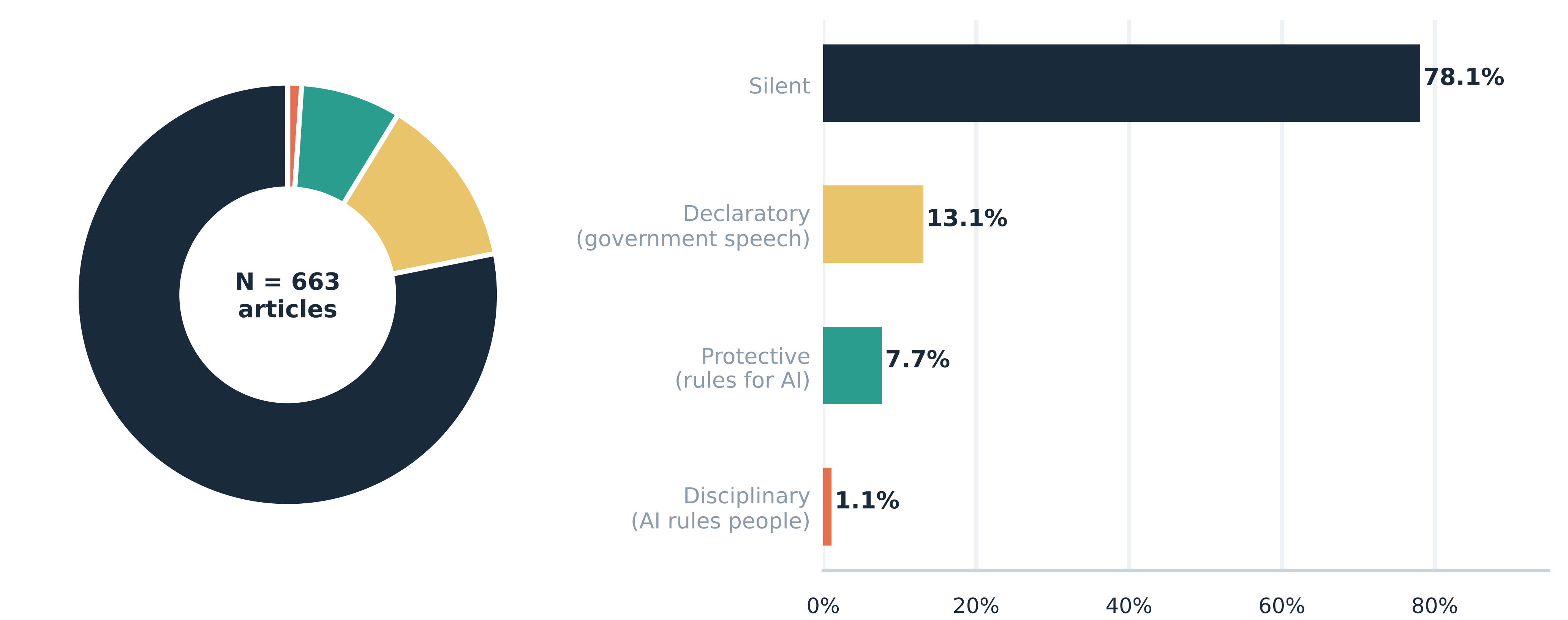
The central result of this exercise is that substantive governance coverage (protective or disciplinary) appears in only 8.7% of articles. The larger share of what looks like governance coverage consists of articles that mention governance in passing, usually by quoting an official invoking responsibility or ethics, without reporting on what the rules actually are, whom they bind, or how they are enforced.
Another finding is also important when reading these shares. The distribution is shaped by the type of outlet involved. The protective share is raised substantially by Kazinform, the official state news agency, where 16.0% of articles fall into that category, because reporting on legislation is a core part of its institutional function. Much of the substantive regulatory coverage in the dataset therefore originates with state media rather than with independent outlets. This point is worth bearing in mind when interpreting outlet differences below.
Is this changing over time?
The share has declined over the study period. In 2023, 88.7% of AI articles said nothing about ethics or privacy. By 2025, that share had fallen to 70.8% (Figure 6).
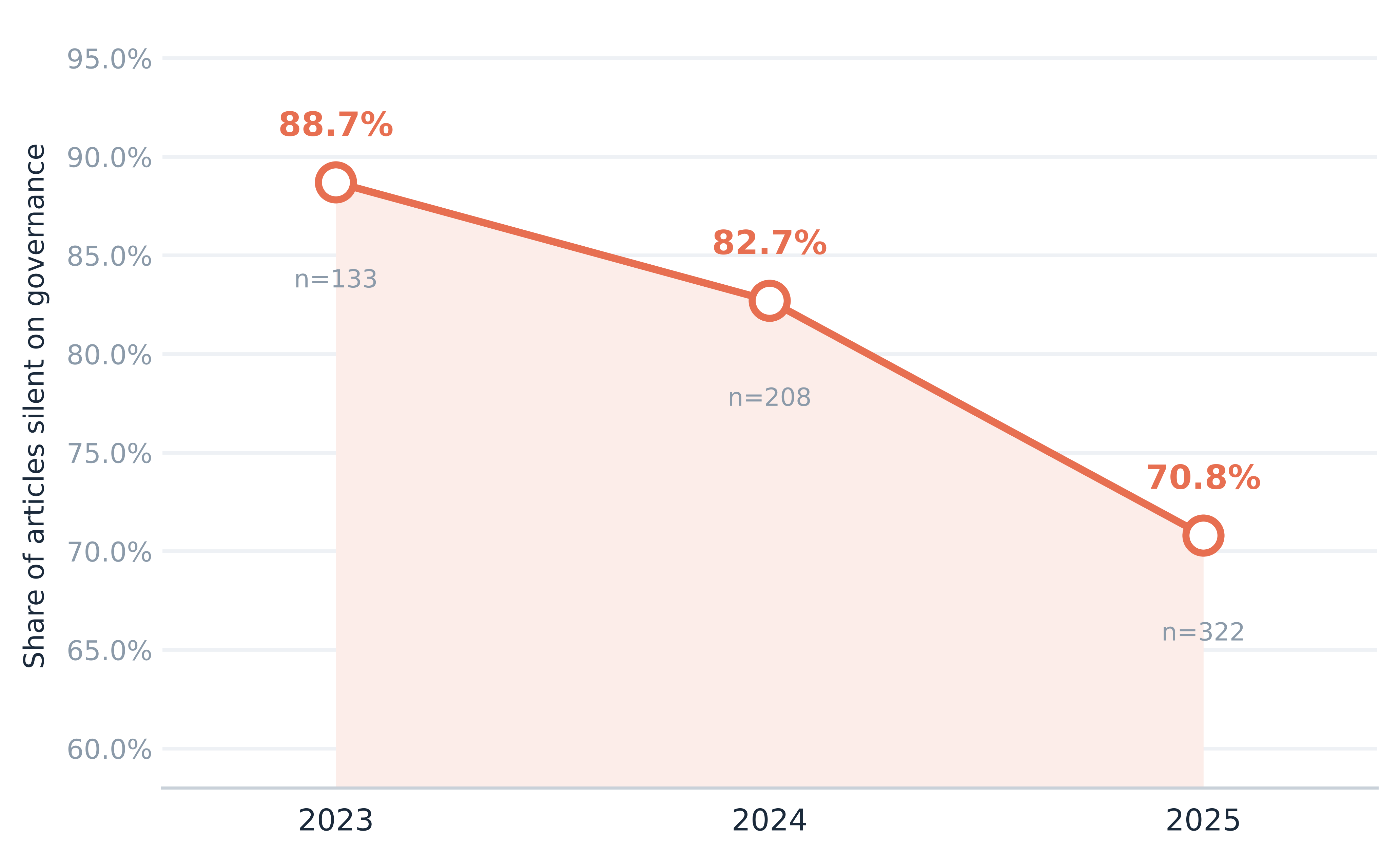
But the trajectory is slow, and 2025 is the year Kazakhstan passed both a Law on Artificial Intelligence and a Digital Code. Even then, seven in ten AI articles offered readers no engagement with the governance dimensions of the technology. As AI moves from announcement to implementation, as facial recognition systems go live, as government databases are integrated with AI tools, as algorithms begin to influence public services and benefits decisions, the gap between the scale of the change and the depth of public conversation about it remains wide.
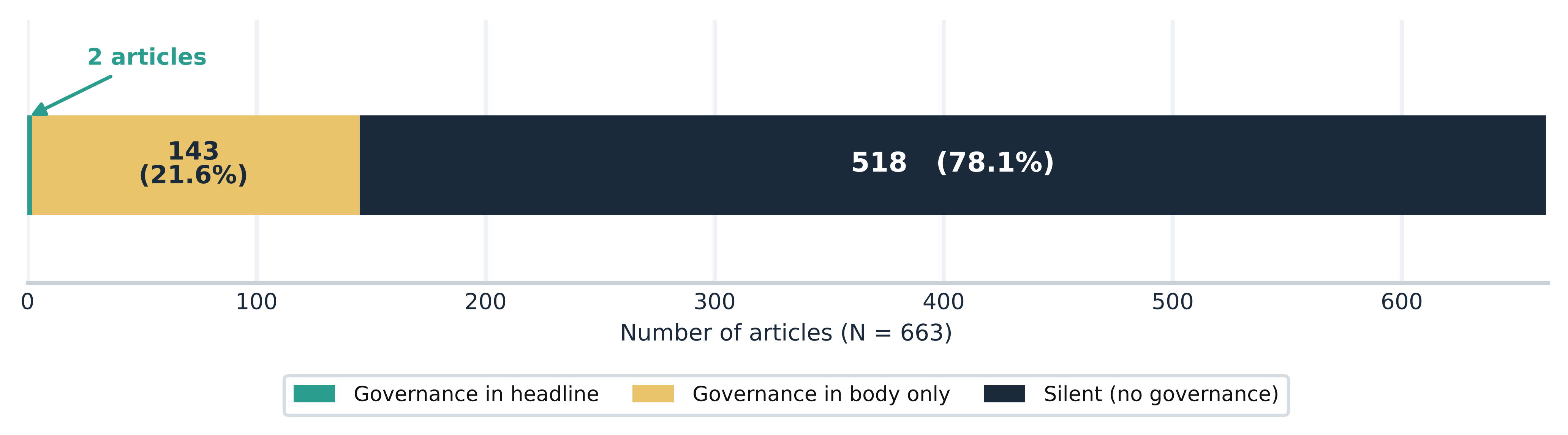
One further finding sharpens this. Of the 145 articles that do discuss governance, exactly 2 signal it in the headline (Figure 7). For anyone reading through headlines, feeds, or aggregators, which is to say most people, AI governance in Kazakhstani media is very nearly invisible.
How does this compare to other countries?
Governance concerns are underrepresented in AI coverage across the world, not just in Kazakhstan. A comparative study of AI coverage in 12 countries found that articles focused on ethics, regulation, and data privacy accounted for only about 6% of all AI-related frames globally, even in contexts where such debates are more openly contested. AI coverage everywhere tends to be optimistic about its applications.
What distinguishes Kazakhstan is not the level of ethics coverage in absolute terms, but the absence of differentiation. Research on UK media found that left-leaning outlets are significantly more likely to cover AI ethics, algorithmic bias, and privacy concerns than right-leaning ones, meaning the political spectrum produces meaningful variation in how AI is framed. In the United States, analysts have documented a shift from early techno-optimism toward more critical coverage as AI became embedded in daily life. In Kazakhstan, neither pattern appears. All outlets, regardless of editorial positioning or ownership, converge on the same modernisation frame, and none has emerged as a consistent voice for governance concerns.
Who Gets to Speak
This is where the study produced its most striking result. We recorded whose voices appear in AI coverage.
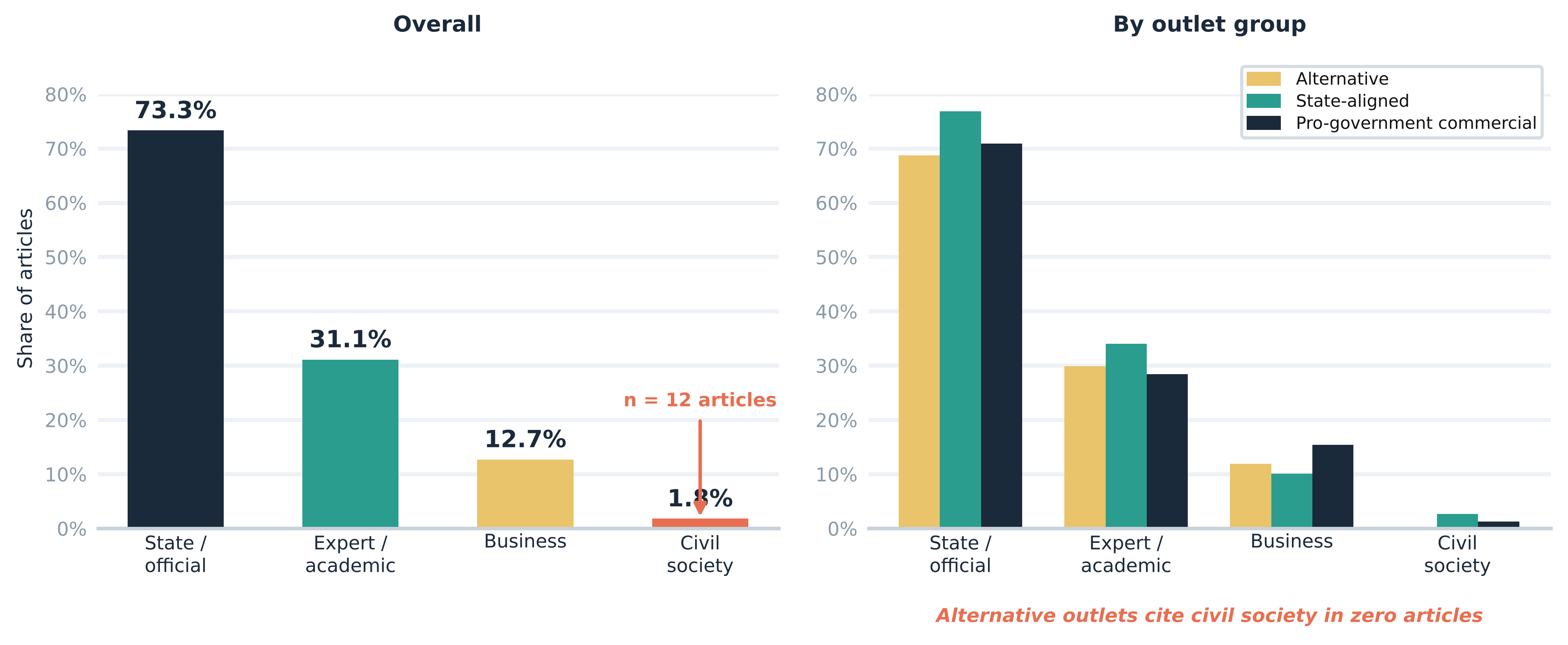
State and official sources, including ministries, akimats (local executive bodies), and government press services, appear in 73.3% of articles (Figure 8). Experts and academics appear in 31.1%. Business voices appear in 12.7%. Civil society organisations, including human rights groups, NGOs, and activists, appear in 12 articles out of 663. That is 1.8%.
Broken down by outlet, the finding sharpens rather than softens. The alternative outlets, Vlast.kz and Ulys Media, the two most frequently described as genuinely independent, quote civil society organisations in zero articles. Not a small number. None, across 67 articles.
This matters because it offers an explanation for outlet convergence that does not require assuming journalists are being told what to write. Media researchers call this indexing: coverage reflects the range of voices available in elite debate. In Kazakhstan's AI domain, that range is almost entirely governmental. Independent outlets are not declining to report civil society perspectives on AI so much as operating in an environment where organised civil society is not an established voice on the subject.
That level is low, but it is not unique to Kazakhstan. Studies of UK and German AI coverage each found civil society cited in roughly 4% of articles, and an audit of New York Times reporting found that 3.5% of those quoted came from civil society organisations. What differs is who occupies the space instead. In those countries the dominant voice belongs to the commercial technology industry, accounting for 67% of people quoted in the New York Times study. In Kazakhstan, business voices account for 12.7% while state and official sources account for 73.3%. Civil society is marginal in both settings, but where AI coverage in Western media is dominated by industry, Kazakhstani coverage is dominated by the state. That inversion follows from the state-led model described at the outset. When the government initiates, funds, and announces AI development, officials become the default source for AI news.
Unexpected News Outlet Differences
Before conducting the analysis, we expected independent outlets to cover AI governance concerns more frequently than state-aligned or pro-government commercial ones. The assumption was intuitive: if Vlast.kz and Ulys Media position themselves as critical of government decisions, they might be more likely to examine the oversight, accountability, and rights dimensions of government-led AI adoption.
That expectation was not confirmed. We ran five statistical models, each accounting for a different factor (article length, topic, year, and source structure), and in none of them did any outlet group stand out as significantly different from the others in whether it discusses governance at all. Ulys Media, which describes its mission as covering what others avoid, is 87.8% silent, the most silent outlet in the study (Table 2).
| Outlet | Articles | Silent | Declaratory | Protective | Disciplinary |
|---|---|---|---|---|---|
| Tengrinews.kz | 161 | 73.3% | 20.5% | 6.2% | 0.0% |
| Informburo.kz | 138 | 77.5% | 14.5% | 8.0% | 0.0% |
| baq.kz | 222 | 82.0% | 10.8% | 5.0% | 2.3% |
| Kazinform | 75 | 74.7% | 6.7% | 16.0% | 2.7% |
| Vlast.kz | 26 | 73.1% | 15.4% | 11.5% | 0.0% |
| Ulys Media | 41 | 87.8% | 2.4% | 9.8% | 0.0% |
| Overall | 663 | 78.1% | 13.1% | 7.7% | 1.1% |
There is one real difference, and it concerns quality rather than quantity. Among the non-silent articles of the pro-government commercial outlets, 28.4% are substantive, as they report on actual rules, obligations, or enforcement rather than repeating official statements, compared with 58.3% for alternative outlets. That difference was found to be statistically significant, suggesting that these outlets mostly recite the official announcements.
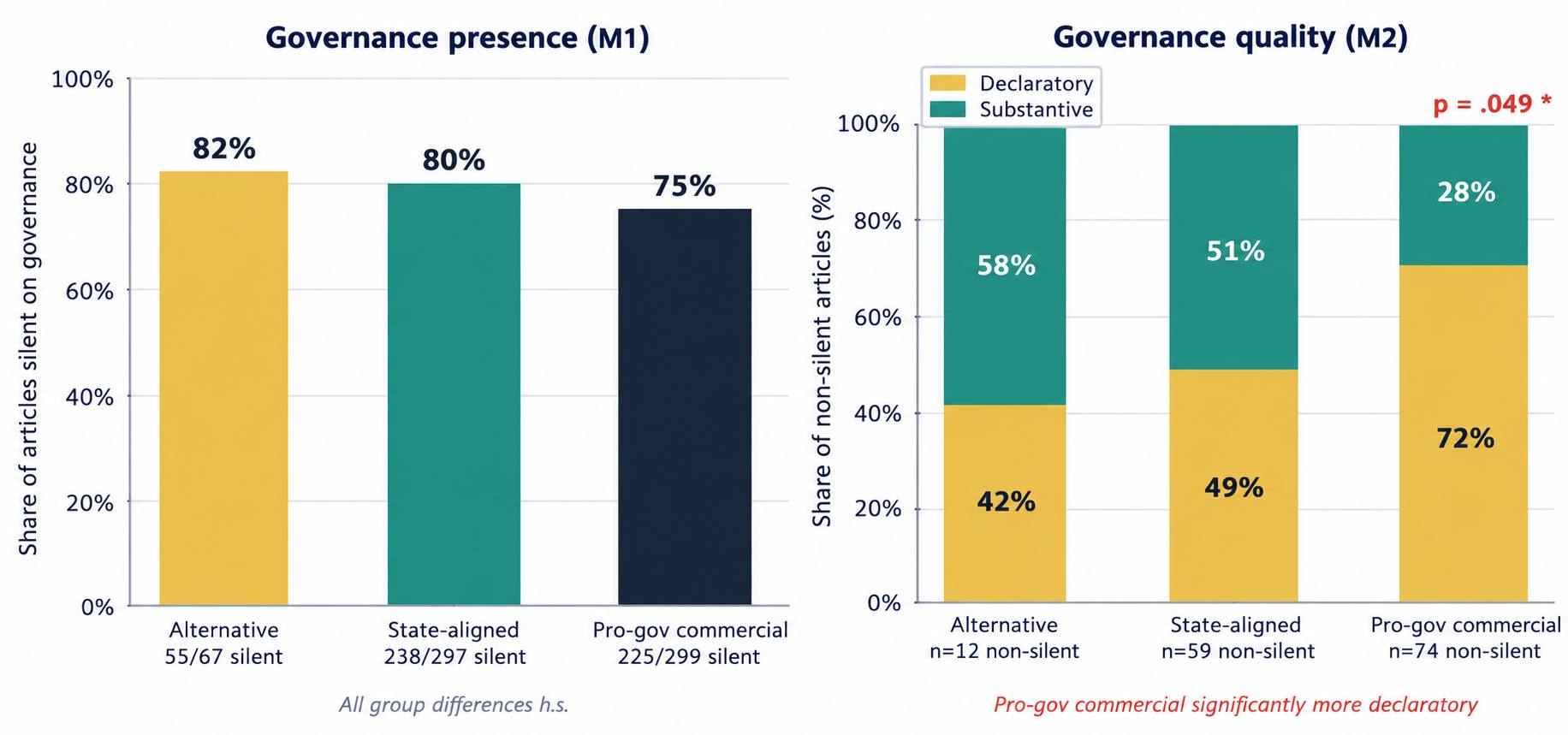
Yet the more important finding is the overall pattern. No outlet, regardless of ownership type, consistently foregrounds governance concerns over modernisation narratives. The pattern of silence does not seem to be a product of state alignment, as it runs through the media environment as a whole.
This challenges a common assumption drawn from research in Western democratic contexts: that editorial independence produces meaningfully different coverage of sensitive policy issues. In Kazakhstan's media environment, the association of AI with modernisation and progress appears strong enough to shape editorial judgment regardless of the formal editorial alignment.
Why Does the Story Look the Same Everywhere?
Several factors converge to produce the consistent pattern we observe, and one of them turned out to be far more strongly associated with governance coverage than the rest.
Informational source dependence
News reporting on emerging technologies relies heavily on official announcements, government press briefings, and institutional communications. These sources are designed to convey implementation progress and expected benefits, not to flag risks or invite scrutiny.
Our agenda-timing analysis supports this. We clustered articles with near-identical titles across outlets to identify who publishes first. Of 10 clusters involving more than one outlet, 6 showed same-day publication across different ownership types. When President Tokayev signed the AI Law on 17 November 2025, four outlets (Vlast.kz, Informburo, Tengrinews, and Kazinform) published on the same day. Rather than one outlet consistently leading and others following, the most common pattern is simultaneous coverage. The straightforward explanation is that they are all working from the same official source: a government press release or institutional briefing that reaches every desk at once. When journalists reproduce this language, they are not necessarily making an editorial choice to suppress governance concerns. They are following the standard workflow of daily news production.
Audience expectation
Research on public attitudes toward digital technologies in Kazakhstan suggests that many citizens associate digitalisation with convenience and progress. When audiences expect technology to bring benefits, coverage that emphasises efficiency and modernisation lands in receptive soil. Coverage of algorithmic risks or data governance may feel abstract to readers who have seen online public services and mobile banking improve their daily lives. This dynamic is not unique to Kazakhstan. It appears to some degree in many middle-income countries where digital infrastructure has expanded rapidly in recent years.
Political context
Kazakhstan operates within a managed public sphere in which open debate exists but tends to remain within certain thematic limits, particularly on matters tied to government authority and national development strategy. Scholars studying similar environments describe governments shaping information not by suppressing debate directly but by promoting narratives so strongly associated with progress that alternative frames become hard to sustain. In this framework, AI is presented not as a policy choice to be debated but as a historical inevitability to be embraced.
And the factor that mattered most
We ran several statistical tests to examine mechanisms that the scholarly literature suggests are plausible, and most of them did not hold. Leader-centric coverage does not appear to account for the silence: articles mentioning the president are not significantly more likely to carry empty governance language. Whether the AI is deployed by the state or by a private company does not account for it either: silence rates are 73.7% and 73.3% respectively, statistically indistinguishable. Even source structure does not account for it: articles quoting only official sources are barely more silent than articles quoting a wider range.
What we find instead is an overwhelming association with article length. The median AI news article in our dataset is 236 words. Longer articles are far more likely to discuss governance, and adding length to the statistical model more than doubles its explanatory power, far more than outlet identity, source structure, or year. Based on these results, one could argue that silence is not necessarily a decision to leave governance out of an article, but the result of covering AI through short institutional announcements in which governance concerns have nowhere to appear. The decision that produces it need not be editorial suppression in individual articles. It is more likely to be the prior decision to cover artificial intelligence predominantly as a stream of brief government announcements.
This does not make the silence less consequential, but it locates it differently. The decision that produces it does not have to be editorial suppression in individual articles. It is likely to be the prior decision to cover AI predominantly as a stream of brief government announcements. That pattern would likely persist under a considerably freer press unless the format of coverage also changed.
The result is a media environment in which, whether by structural constraint, professional habit, genuine shared belief in technological progress, or simply the shape of a 236-word news brief, the story of AI in Kazakhstan reaches the public almost entirely through the lens of modernisation.
A Note on Methodology and Limitations
This analysis uses dictionary-based content analysis, a method that identifies the presence of thematic keywords across a large body of text. It tells us what topics appear in AI coverage and how frequently, but not how those topics are argued or interpreted within individual articles. The search process relied on word stems rather than complete word forms, allowing a single entry to capture multiple inflected variants of a term. The analysis covers Russian-language articles and therefore does not capture potential differences in Kazakh-language coverage. Findings reflect patterns in Russian-language online news rather than Kazakhstan's media environment as a whole. The two alternative outlets, Vlast.kz and Ulys Media, contribute 67 articles between them. Findings specific to these two outlets rest on a small number of articles and should be read with corresponding caution. A full keyword list, the dictionary validation procedure, regression results, and a complete methodology description can be found in the supplementary reading material to this article.
AI use statement. Claude AI (Anthropic) assisted with cross-checking numerical values across tables and figures for internal consistency, generating figures, and document formatting. The keyword dictionary, statistical analysis, and all interpretive content were developed and verified by the authors.
Peer Review: Mukhtar Amanbaiuly, Zhanserik Temirtashev, Aziza Laichinova
Expert Review: Dr. Zhanibek Arynov, Dr. Alexei Trochev, Dr. Vladimir Kozlov, Alisher Juzgenbayev, PhD candidate
An earlier version of this paper was presented at the Central Eurasian Studies Society Regional Conference 2026 and benefited from the questions from the audience.
The research team is grateful to the reviewers for their thorough comments.
The views expressed in this paper are solely those of the authors and do not necessarily reflect the position of Inside Kazakhstan or of any of the reviewers.